A messaging framework template turns customer research into one shared page: your audience, their pain, three value pillars, proof and the words to use. To write one, lock the audience, mine customer evidence for pains and phrases, draft the pillars, fill the table, then test it with buyers.
Key takeaways
- Start from what customers said, not from what the team wants to claim.
- Keep it small: one audience at a time, three value pillars, and proof for every claim.
- Use customers' own words in each cell, and record which source each phrase came from.
- Test the draft with five buyers, ship it at about 85% done and review it on a schedule.
How to… · Product marketing
Why do messaging frameworks fail?
Most messaging frameworks are written in a workshop, from opinions. Everyone leaves agreeing, and the buyer still doesn't recognise themselves in the words.
The problem is common. In Forrester's 2023 B2B Brand and Communications Survey, 44% of marketing leaders said their messaging doesn't meet the needs of all audiences. And 37% said conflicting messages from across the company confuse buyers.
Even experts struggle to tell vendors apart. In a June 2026 Wynter survey of 100 B2B SaaS marketing leaders, marketers averaged 1.86 out of 5 when matching real value propositions to the right brands. Random guessing scores 1.0.
A framework built from customer evidence fixes the root cause. Every claim traces back to something a customer said, so arguments about wording become questions about evidence.
What goes in a messaging framework?
Agencies describe the parts slightly differently. The Starr Conspiracy's framework guide (2026) lists strategic inputs, a core narrative, value pillars, audience messages and an activation plan. This guide keeps the same shape but starts each part from research.
| Part | What it answers | Where the evidence comes from |
|---|---|---|
| Audience and decision | Who are we talking to, and what are they deciding? | Recent buyer interviews, deal notes |
| Pain, in their words | What problem do they name, and how do they say it? | Interviews, calls, tickets |
| Outcome | What do they want to be true afterwards? | Interviews, win-loss notes |
| Value pillars | What three things do we claim? | Patterns across customers |
| Proof | Why should they believe each claim? | Customer results, product facts |
| Objection | What stops them choosing us? | Lost deals, sales calls |
| Phrases to use and avoid | Which words are theirs, and which are ours? | Verbatim quotes |
Step 1: Lock the audience and the decision
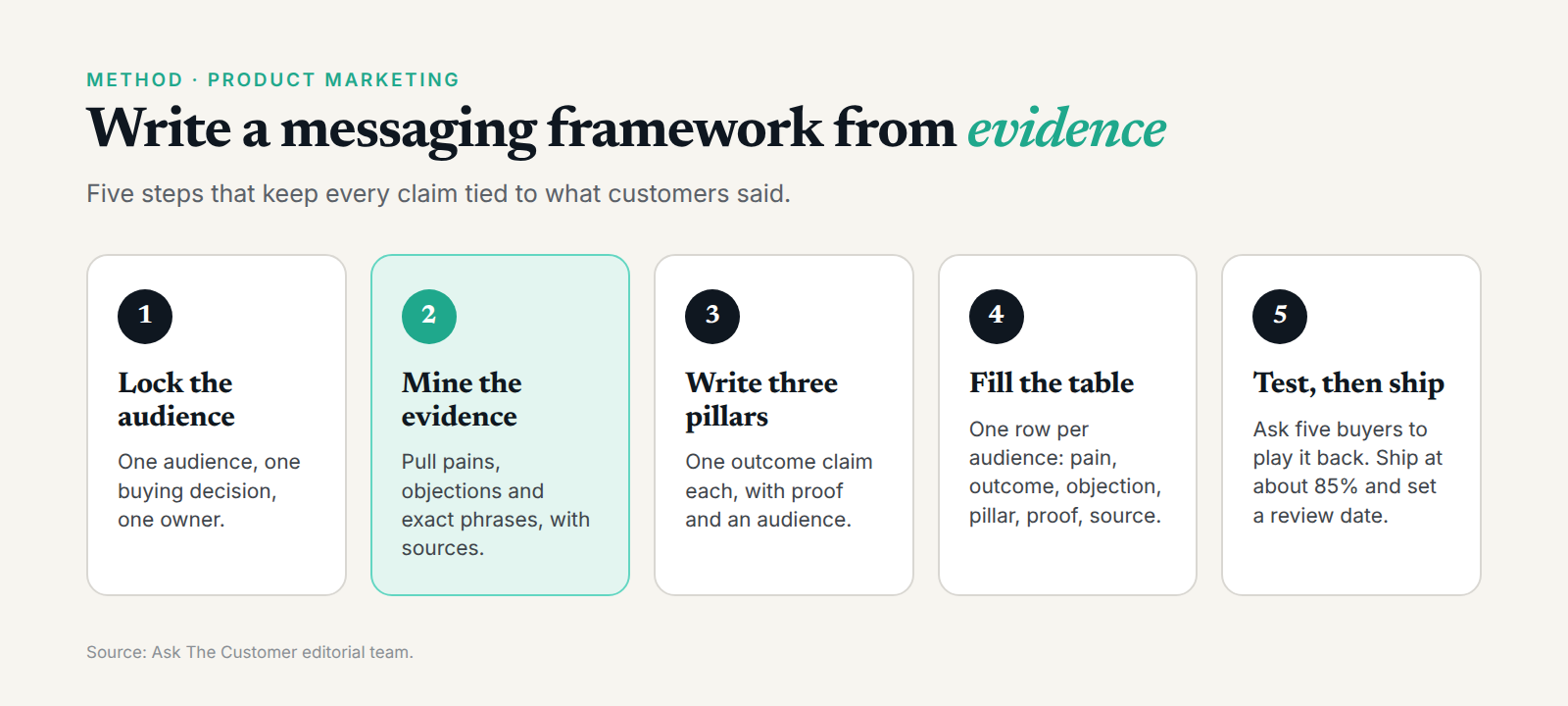
Pick one audience and one buying decision. "Product marketers choosing a research approach" is a decision. "Everyone in B2B" isn't.
Write down what you already believe about this audience. You'll check those beliefs against the evidence in the next step. If you serve several audiences, build one framework per audience and compare them later.
Decide who owns the final wording. One person should. You'll thank yourself in step 5.
Step 2: Mine your customer evidence for pains and phrases
Gather what customers and prospects have already said: interviews, sales and support calls, tickets, survey comments and win-loss notes. Keep current customers and prospects apart. They often describe the same product differently, and mixing them blurs both.
Then read for four things: the problem they name, the old way they cope, the outcome they want and the worry that nearly stopped them. Copy the exact phrases into a sheet with the speaker and source. Our guide to voice of customer copywriting shows how to build that phrase bank.
Count different customers, not mentions. Ten emails from one account is one signal. If you only have a few sources, say so. A thin pattern is a hypothesis, not a finding.
If your evidence is scattered, Ask The Customer's Customer Map groups uploaded interviews, calls and tickets into personas with pains, objections and vocabulary, each linked to its source records. It's in Early Access.
Step 3: Write three value pillars
A value pillar is one claim about the outcome you deliver, not a feature. "Faster reports" is a feature. "You'll send numbers to finance without retyping them" is a claim a customer would recognise.
For each pillar, write three things:
- A one-sentence claim in the customer's words.
- Three to five proof points: results, product facts or customer evidence you can show.
- The primary audience it's for.
Check each claim against your step 2 sheet. If no customer ever described that pain, it isn't a pillar yet. It's something to test, as in our guide to validating a product idea before building it.
Step 4: Fill in the framework table
Now put it on one page. Use one row per audience and one column per element. This is the table to copy.
| Audience | Their pain, in their words | Outcome they want | Objection to answer | Value pillar | Proof | Source records |
|---|---|---|---|---|---|---|
| Buyer role or segment | Exact phrase or close paraphrase | What changes for them afterwards | The worry that nearly stopped a past buyer | One-sentence claim | Result, fact or customer evidence | Which interviews, calls or tickets |
| Second buyer role | Exact phrase or close paraphrase | What changes for them afterwards | The worry that nearly stopped a past buyer | One-sentence claim | Result, fact or customer evidence | Which interviews, calls or tickets |
Add a short core narrative above the table. Four sentences is enough: what's changed, why the old way fails, the new way and your role in it.
Keep a "words to use, words to avoid" list beside it. Customers' phrases go in the first column. Internal jargon goes in the second.
Step 5: Test it with real buyers, then ship
Show the draft to five people who match your audience. Ask one question: "In your own words, what does this company do and who is it for?" Don't explain first.
If their version is clearer than yours, use theirs. Run the same check with different buying roles, because a line can land with one role and worry another. Our discovery call use case shows how past objections can shape what you ask.
Then ship at about 85% done. A framework that stays "almost finished" for months helps nobody. Put a review date in the file, and update it when new evidence arrives.
AI can help you sort evidence and draft options, but it doesn't replace talking to real customers. Use real conversations to confirm any claim that matters.
What are the common mistakes?
- Writing pillars before the evidence. You end up defending opinions. Do steps 1 and 2 first.
- Describing features, not outcomes. If the pillar names a feature, ask what the customer gets from it.
- Blending every stakeholder's input. Collect views, but let one owner decide the wording.
- Using our words, not theirs. Internal terms sound precise inside the company and vague outside it.
- Filing it and forgetting it. Add a review date and a place where sales and marketing both use it.
- Treating one loud customer as a pattern. Count distinct customers.
When should you use another method?
If you have almost no customer evidence, don't write a framework yet. Run 5 to 10 interviews first, or start with a quick message test.
If you're choosing between two directions, a headline test or preference test may answer faster than a full framework. If your issue is where you sit in the market, that's a positioning question. Settle it before you write the framework.
FAQ
What is a messaging framework?
A messaging framework is a one-page reference that says what you say, to whom and why they should believe it. It usually holds the audience, their pain, your value pillars, proof points and the words to use. Writers, sales and product teams all work from the same page.
How is a messaging framework different from positioning?
Positioning decides where you sit in the market and who you're best for. A messaging framework turns that decision into the claims, proof and phrases people actually say and write. Positioning changes rarely. The framework is revised more often, as you learn how buyers react to the words.
How many value pillars should a messaging framework have?
Three is a sound default, and four is the practical limit. More than that and nobody remembers them, so every campaign ends up picking a different set. Each pillar needs one clear claim, a few proof points and a named primary audience, or it's a slogan rather than a pillar.
How much customer research do you need first?
Enough to hear the same pain from several different customers, using different words. For one audience, that's often 5 to 10 interviews or call transcripts plus support tickets. If you can't find a pattern, say so in the framework and mark those cells as untested rather than filling them with guesses.
Who should own the messaging framework?
One named person should own the final wording, usually in product marketing. Many people can add evidence and comments, but a single owner decides the language. Without that, every stakeholder's view gets blended in until the message persuades nobody. Add a review date so the page doesn't go stale.
Sources
- Forrester: B2B Messaging Is Fractured, But It Doesn't Have To Be (2023 B2B Brand and Communications Survey figures)
- Wynter Research: B2B vendor differentiation survey (June 2026)
- The Starr Conspiracy: Messaging framework template guide (May 2026)
- How to do voice of customer copywriting with real evidence (Ask The Customer)
- How to validate a product idea before building it (Ask The Customer)
- Prepare for a discovery call using objections you've already heard (Ask The Customer)
Last updated: 22 October 2026
Don't guess. Ask the customer.