Voice of customer copywriting means writing from the exact words customers use, not the words your team prefers. Gather interviews, calls, tickets and reviews, copy out exact phrases, group them by theme, count how many different customers say each one, then write and test your copy against real buyers.
Key takeaways
- Customers describe problems in plain words, and those exact phrases usually beat copy written from the inside.
- Your best raw material is evidence you already hold: interviews, sales calls, support tickets and reviews.
- A phrase bank with source, speaker and theme turns scattered quotes into something you can search and reuse.
- Count distinct customers, not mentions, so one loud voice doesn't become your headline.
- Test borrowed language with real buyers before you publish it.
How to… · Marketing
Why does your copy sound like you, not your customers?
Most product copy is written from the inside. Teams describe what they built, using the words they use in meetings.
Buyers notice. In a May 2018 TrustRadius poll of 769 software buyers, about 3 in 4 called vendor marketing language jargon or fluff. The poll is a few years old, but the lesson holds. Words that make sense to you can mean nothing to a stranger.
The fix isn't a cleverer tagline. It's borrowing the words customers already use. That's voice of customer copywriting, and you can start with a spreadsheet and a few hours.
What is voice of customer copywriting?
It means writing from the exact language customers use to describe their problems, goals and doubts. You don't invent the message. You find it, then arrange it.
It differs from a satisfaction score. A score tells you how people feel. A phrase tells you how they talk.
Copy built this way does three things. It names the problem the way the reader would. It uses their vocabulary for the solution. And it answers the worry they'd say out loud.
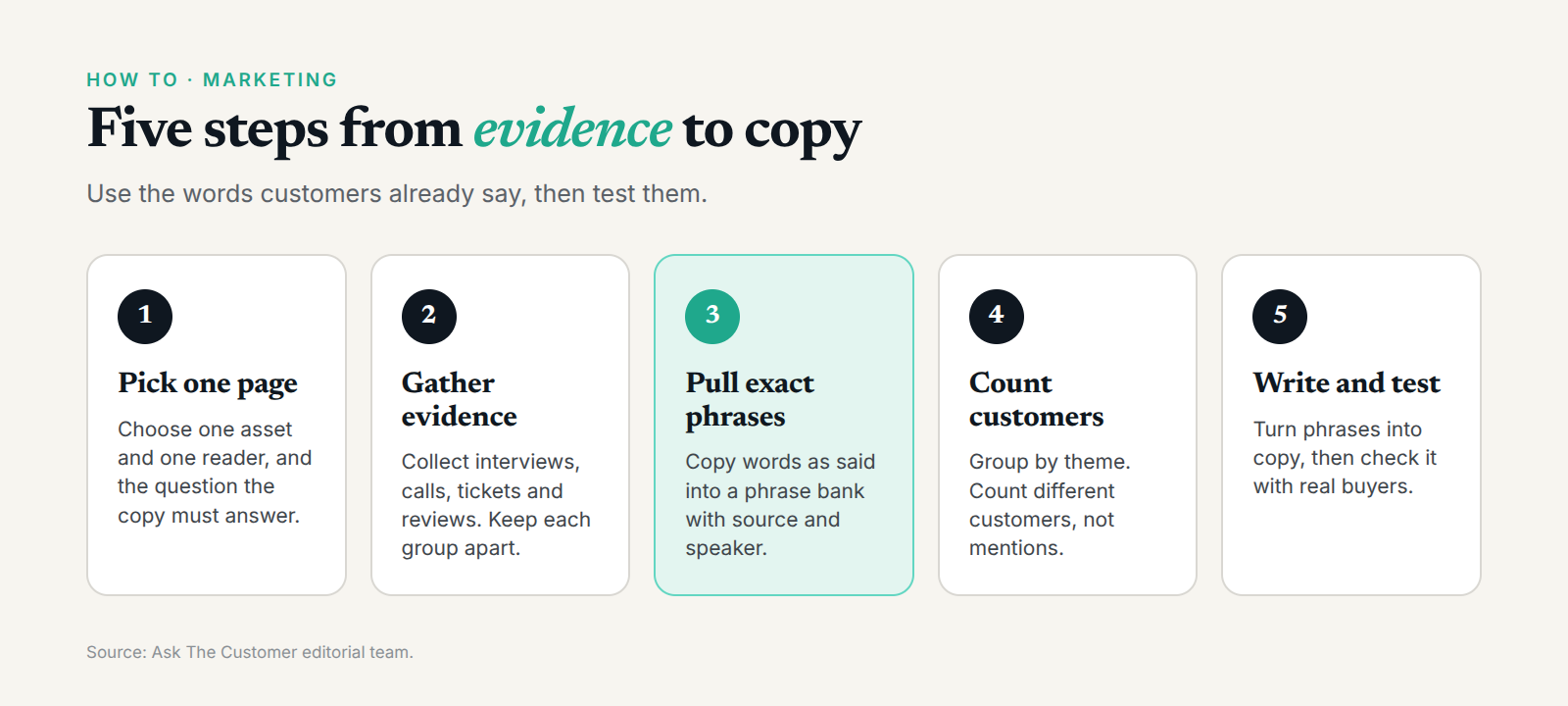
Step 1: Pick one page and one reader
Don't mine everything. Start with one asset, such as a homepage headline, a launch email or a pricing page. Then name one reader, such as a head of operations at a mid-sized firm.
Write down the question the copy must answer. For example: "What makes someone start looking for this?" That question tells you which phrases to hunt for.
Ten minutes here saves hours later. Without it, you'll collect hundreds of quotes and not know which matter.
Step 2: Gather the evidence you already have
Start with what's in your folders. Customer interviews, recorded sales calls, support tickets, chat transcripts and onboarding notes all hold unprompted language.
Then add public sources to see the wider market. Reviews, community threads and forums show how people talk when you're not in the room. The Wynter guide suggests going deep on two or three communities rather than skimming many, and starting with at least five call transcripts.
Keep each kind of evidence apart in your notes. Current customers, prospects and the open market are different groups, and blending them hides what separates them.
If you're running new interviews to collect language, our guide on how to write customer interview questions that aren't leading helps you hear their words, not yours. And our guide on how to validate a product idea before building it shows why asking about past behaviour gets more honest language than asking about future intent.
Step 3: Pull out exact phrases, not summaries
Read each source and copy phrases word for word. Don't tidy them. The clumsy version is often the useful one.
Look for six kinds of language: the problem in their life, what they've tried, what made them start looking, what they hoped for, what they valued, and what made them hesitate. Copyhackers organises review mining in a similar way, and CXL suggests asking about the trigger event, the alternatives considered and the hesitations before buying.
Record each phrase in a phrase bank. Copy this table into a spreadsheet and add a row per phrase.
| Exact phrase | Source | Speaker role | Type | Theme | Customers who said it | Possible use |
|---|---|---|---|---|---|---|
| The customer's words, unedited | Interview 3, minute 12 | Operations lead | Problem | Manual reporting | 4 | Headline |
| The words they used for the old way | Support ticket 218 | Finance manager | Alternative | Spreadsheet workaround | 3 | Subhead |
| The trigger, in their own words | Sales call 7 | Head of marketing | Trigger | Board asked for numbers | 2 | Opening line |
| The worry, as they said it | Call 11, objection | IT admin | Hesitation | Security review | 5 | Objection line |
These rows show the format only. Fill yours with real phrases and keep the source so you can check it later.
If your interviews and tickets already sit in files, Ask The Customer builds personas with the vocabulary customers use and links each one to the records behind it, so you can check the source. You can join Early Access to try it on your own evidence.
Step 4: Group by theme and count customers, not mentions
Sort the phrases into themes: problems, triggers, goals, alternatives and worries. Then count how many different customers said something similar.
Ten mentions from one account is one signal. Ten customers saying it in different words is a pattern. It's the same rule we use when we prioritise feature requests from customers.
Rate each theme as strong, medium or thin. Strong means many customers across several sources. Thin means one voice, so treat it as an idea to test, not a headline.
Also note what's missing. If nobody mentions your favourite feature, that's a finding too.
Finally, pick the words customers use for the thing you sell. If they say "report" and you say "analytics dashboard", use "report".
Step 5: Turn phrases into copy, then test it
Now write. Use the customer's problem in the headline, their vocabulary in the explanation, and the top worry in a short objection line.
| Theme from the evidence | Typical team-language copy | Copy built from customer language | Check before publishing |
|---|---|---|---|
| Problem named by many customers | A feature-led claim about your product | The problem, in the words customers used, followed by the outcome | Would a customer say "that's me"? |
| Old way they use today | A claim about being better than alternatives | A line that names the workaround they know | Is the workaround described accurately? |
| Trigger that starts the search | A general benefit statement | The moment that made them look, in their terms | Does it match several customers, not one? |
| Common hesitation | Silence, or a vague reassurance | A plain answer to the worry, with proof you can show | Can you back it with real evidence? |
Use direct quotes sparingly, and only with the customer's permission. A paraphrase that keeps their vocabulary is often enough.
Then test. Show the draft to 5 to 10 people who match your reader and ask what the company does, in their own words. If their version is clearer than yours, use theirs.
What are the common mistakes?
- Building a headline from one loud customer. Count different customers first.
- Mixing customers and prospects. Their language differs, and the gap is useful.
- Using only the happiest and angriest reviews. Wynter notes that extreme reviews can be skewed, so read the middle too.
- Polishing a phrase until it sounds like your team again.
- Copying words without their context, so a joke or complaint reads as praise.
- Publishing a quote without permission, or inventing one that sounds right.
When should you use other methods?
Use a survey when you need numbers across many people. Use interviews when you need depth on why. Use an A/B test to pick between finished options.
Customer evidence supports your judgement, and so does any AI that reads it. It doesn't replace real customers. If a theme rests on one or two voices, talk to more customers before you build copy on it.
For sales teams, the same evidence works before a call. Our use case on how to prepare for a discovery call using objections you have already heard shows how.
FAQ
What is voice of customer copywriting?
Voice of customer copywriting is writing marketing copy from the exact words customers use to describe their problems, goals and doubts. You collect their language from interviews, calls, tickets and reviews, group it by theme, and use it in headlines, explanations and objection answers instead of inventing your own phrasing.
Where can I find customer language for copy?
Start with sources you own: interviews, sales call transcripts, support tickets, chat logs and onboarding notes. Add public sources such as reviews, forums and community threads to see how the wider market talks. Keep the two apart in your notes so you can compare what your customers say with what the market says.
How many calls or interviews do I need?
There's no magic number. A practical start is five or more calls plus a sample of tickets, then keep reading until new sources stop adding new phrases. Count different customers rather than mentions. If a theme rests on one or two voices, treat it as a hypothesis and check it with more customers.
Can I use customer quotes directly in my copy?
Only with the customer's permission, and only if you quote them accurately. Never invent or polish a quote to make it sound better. Often the safer choice is to paraphrase, keeping their vocabulary but removing names and details that could identify them or their company.
Can AI help me find customer language?
AI can speed up reading and sorting large piles of transcripts, but it can also invent or smooth over wording. Ask it to point to the exact records behind every phrase, then open the sources and check a sample. Treat its themes as a starting point, not as proof.
Sources
- TrustRadius, Software Buyer Poll (May 2018, 769 software buyers; read via the TrustRadius blog post)
- Wynter, how to collect voice of customer data
- Copyhackers, rapid-fire review mining
- CXL, how to use voice of customer research to boost conversions (updated 2024)
Last updated: 20 October 2026
Don't guess. Ask the customer.