To prepare for an enterprise buying committee call, work out who will be in the room and what each person must be able to say yes to. Research the account, plan questions for each role, build the call around goals the whole group shares, and agree a next step that helps the committee align, not just you.
Key takeaways
- Enterprise buying groups are large and often in conflict. Gartner found 74% of buyer teams show unhealthy conflict.
- Map roles, not just names. Each person is asking a different question, even if they sit in the same meeting.
- Aim for committee-level relevance. Help the group agree, rather than winning over one person.
- Plan fewer, better questions and send an agenda ahead.
- End every call with a next step that someone in the buying group owns.
Part of our "How to…" series: practical answers to the questions product, marketing and sales teams ask most.
The short answer
Prepare for the group, not the person you've been emailing. Before the call, work out who will be in the room, what each of them needs to be able to say yes to, and where they're likely to disagree. Then build the conversation around goals the whole group shares.
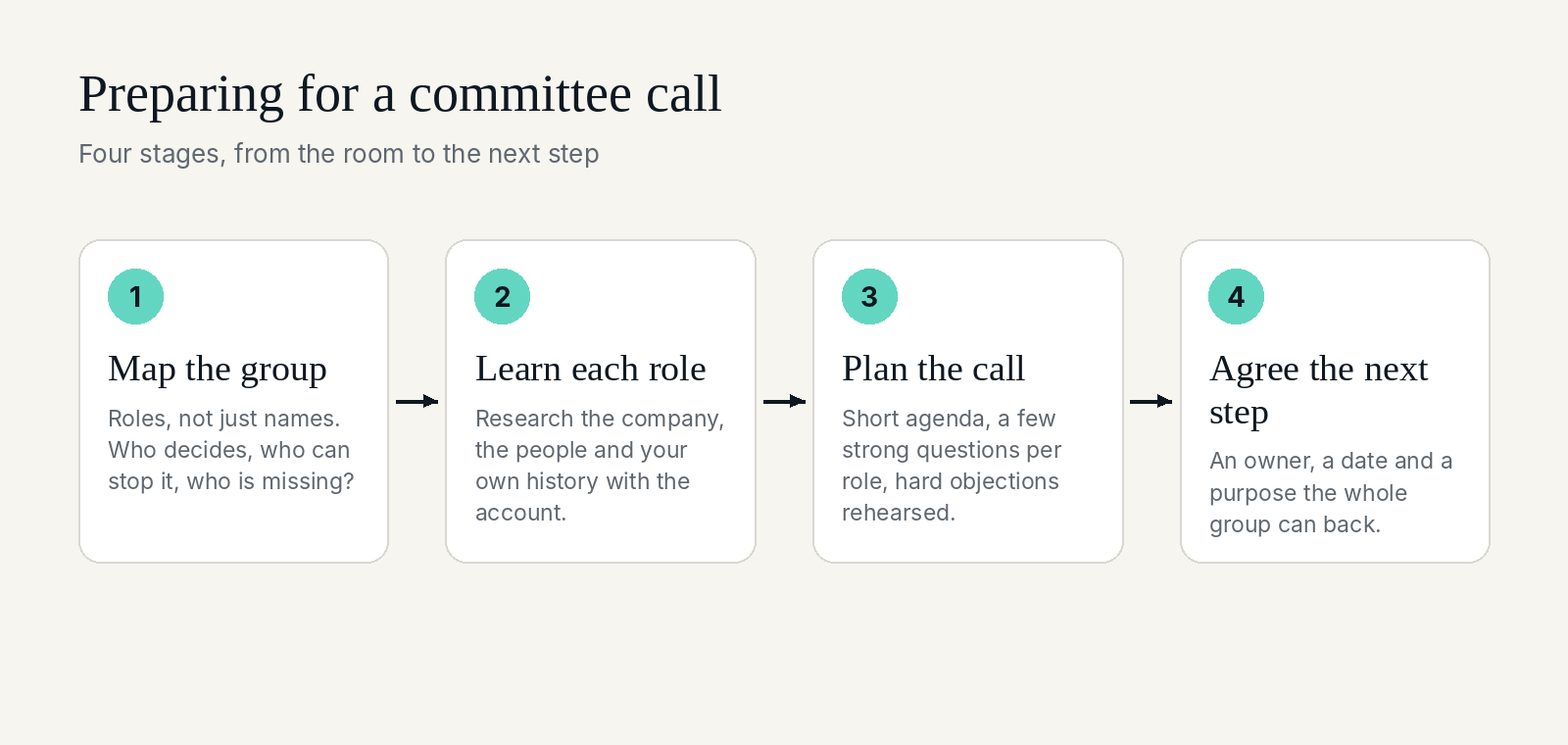
In practice that means four moves. Map the buying group. Learn what each role cares about. Plan a short agenda with a few good questions for each person. Then agree a next step that helps the committee move together, not just you.
This guide walks through each step, includes a role map, and ends with a prep checklist you can copy.
Why it matters: the group is the buyer
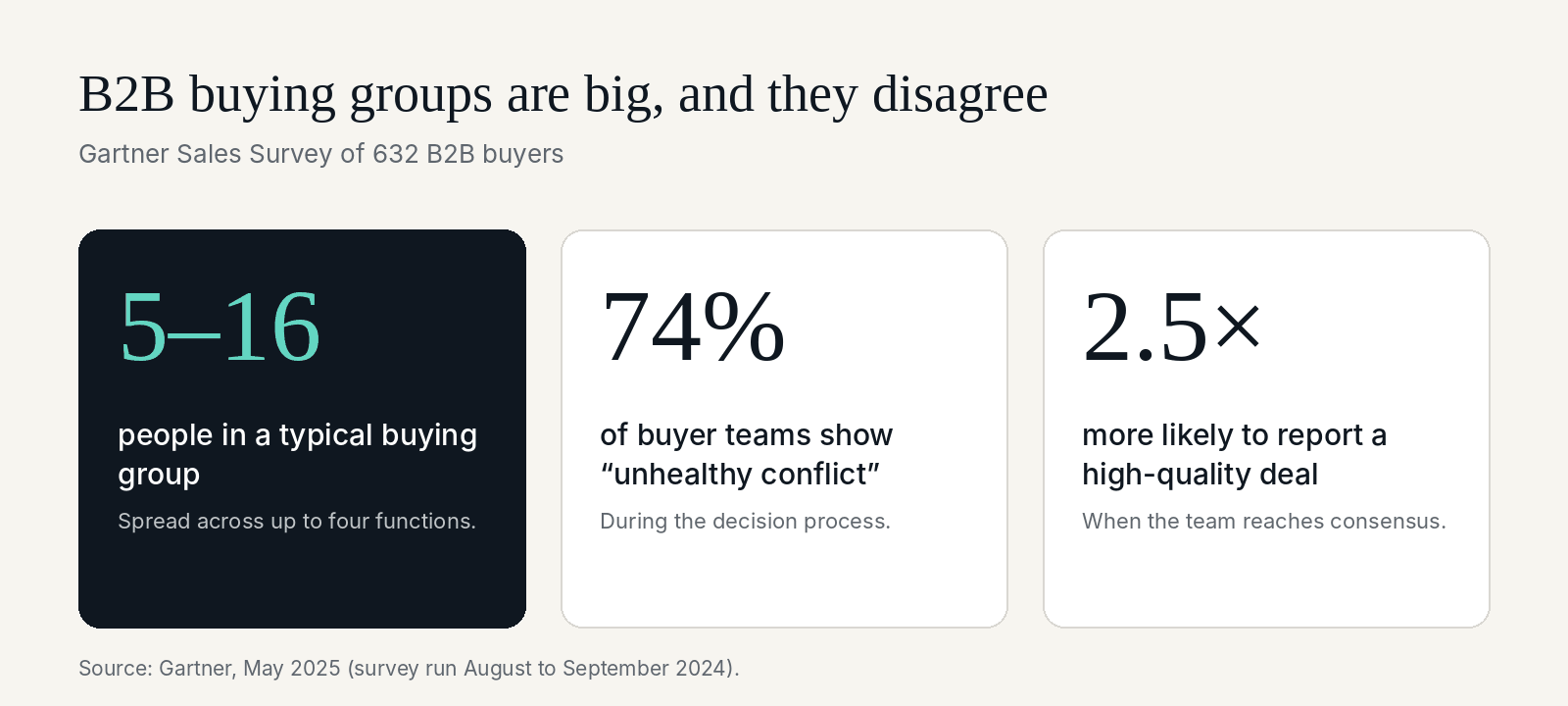
Enterprise purchases are rarely one person's decision. Gartner's 2025 survey of 632 B2B buyers found buying groups of 5 to 16 people spread across up to four functions. Earlier research from CEB, now part of Gartner, put the average at around 11 people, with some complex deals reaching 20.
Groups that size don't always agree. The same Gartner survey found that 74% of buyer teams show "unhealthy conflict" during the decision. Teams that did reach consensus were 2.5 times more likely to report a high-quality deal.
Doing nothing is the other competitor. CEB's research found that about 38% of purchase attempts end in no decision. Often that isn't because the group picked a rival. It's because they couldn't agree.
There's also less time to make an impression than you might think. CEB found buyers spend only 17% of their total buying time with all vendors combined. Split that across several suppliers and a committee, and each call has to count.
Step 1: Map the buying group
Start by writing down who you expect to meet, and who you don't know about yet. Names are less useful than roles, because roles tell you what each person will be listening for.
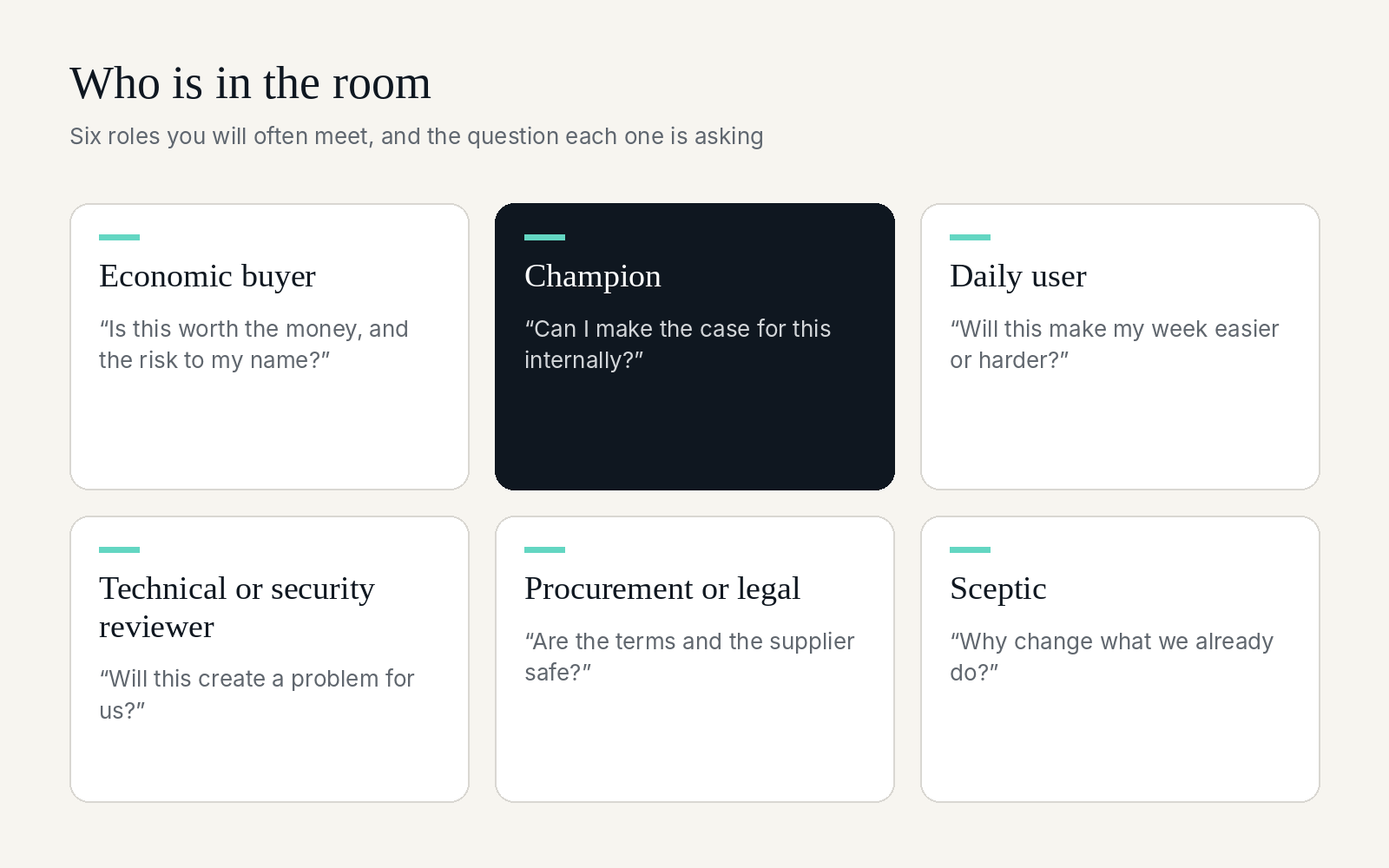
| Role | The question they're really asking | What helps them | Risk if you ignore them |
|---|---|---|---|
| Economic buyer | "Is this worth the money, and the risk to my name?" | Outcomes in business terms, a clear cost, a credible plan. | A late "no" on budget or priority. |
| Champion | "Can I make the case for this internally?" | Material they can reuse, honest answers to hard questions. | They can't sell for you when you aren't there. |
| Daily user | "Will this make my week easier or harder?" | A realistic walk-through of their workflow. | Quiet non-adoption after purchase. |
| Technical or security reviewer | "Will this create a problem for us?" | Clear answers on data, integration and compliance. | A veto in the final stage. |
| Procurement or legal | "Are the terms and the supplier safe?" | Early sight of commercial and contract questions. | Delays, and pressure on price. |
| Sceptic | "Why change what we already do?" | The cost of the status quo, shown with their own data. | Slow-rolling the process. |
Not every deal has all six, and one person may wear two hats. Treat the table as a prompt for questions, not a fixed model.
Then work out where each person stands:
- Who is leading this? Who raised the problem, and who is accountable for solving it?
- Who decides, and who can stop it? The final signatory and the people with a veto are not always the same.
- Who hasn't been mentioned? If you've only met one or two roles, ask your contact who else will have a say. A question like "Who else will need to be comfortable with this?" feels natural, and it often opens the door.
CEB's research on the people it calls Mobilisers suggests it pays to find the person who can build agreement internally. According to its findings, reps who target Mobilisers were 31% more likely to be high performers. That's one finding from one study, but the principle is simple: look for the person who helps the group move.
Step 2: Learn what each role cares about
Do your research before the call, not on it. You can usually learn a lot in an hour.
The company. Read recent results or announcements, strategy statements and job adverts. Note stated priorities, such as cost reduction, a new market or a regulatory deadline. Then link what you offer to something they've said matters, using their wording.
The people. Check each person's role and tenure, and what they've shared publicly. A newly hired executive may want a quick win. A long-serving manager may be protective of an existing process.
Your own history. Look at past calls, support tickets, trial usage and earlier conversations with this account. Which problems did they raise, in what words? What did they object to? If you've sold to similar companies, which questions came up in the later stages? Those are the questions to answer early.
The competition and the status quo. Know what they use today and what it costs them to keep using it. The real alternative is often a spreadsheet, an internal tool or doing nothing.
Write what you find under three headings: what we know, what we think, and what we need to ask. Keep facts and guesses apart. A guess that sounds like a fact causes problems on the call.
Step 3: Plan the call around the whole group
A committee call goes wrong in familiar ways. One person dominates. The conversation drifts into a demo nobody asked for. Or you speak to the person you know best and lose everyone else.
Gartner's 2025 research offers a useful steer. It found that content with relevance to the whole buying group had a stronger link to consensus than content tailored to individuals. Teams who received content relevant to the group were three times more likely to report a high-quality deal. Gartner also warns that individually targeted content can reinforce one person's existing view. In short, aim to help the group agree. Don't try to win each member separately.
Here's a simple structure for a 45 to 60 minute call.
| Part | Time | What you do |
|---|---|---|
| Open | 5 min | Confirm who is on the call, the goal and the agenda. Ask if anything has changed since you last spoke. |
| Shared problem | 10–15 min | Ask about the problem and how it affects each role. Let different views surface. |
| Your approach | 15 min | Show only what connects to what you've just heard. Use their words. |
| Concerns | 10 min | Invite objections directly. Ask each function what would need to be true for them. |
| Next step | 5 min | Agree who does what, and by when. |
Some practical points:
- Send an agenda in advance. Ask your contact to share it with the group and add anything they want covered. It signals respect and shows you who they think matters.
- Choose a few strong questions per role. Don't try to cover everything. Three or four open questions that start with "tell me about…" or "how do you currently…" will do more than a long list.
- Ask about the group, not just the person. "How do the finance and IT teams see this?" is better than "Are you sold?"
- Plan for disagreement. If you already know two roles want different things, say so calmly and ask how the group usually resolves it. Don't pick a side.
- Rehearse the hard questions. List the three objections most likely to come up and agree your honest answers with a colleague beforehand. If the honest answer is "we don't do that", say so.
- Know your deal-breakers. Decide in advance what you can't offer or concede, so you aren't improvising under pressure.
Questions that work well with a mixed group:
- "What changes for your team if this problem is solved?"
- "What happens if you do nothing for the next 12 months?"
- "Who else needs to be comfortable with this, and what will they want to see?"
- "What would make you say no?"
- "What has to happen for this to be a priority this quarter?"
Step 4: Help the committee agree, then agree a next step
At the end of the call, don't just ask for the sale. Ask what the group needs in order to decide. Gartner's 2026 survey of 646 buyers found that buyers who felt confident were twice as likely to report a high-quality deal. Confidence comes from clarity, so make the next step clear.
A good next step has an owner, a date and a purpose. For example: "Your IT lead will send us the security questionnaire by Friday. We'll answer within three working days and set up a 30-minute call with your security team."
Within 24 hours, send a short follow-up that:
- Thanks everyone by name.
- Summarises the problem as they described it, in their words.
- Lists the open questions and who owns each.
- Repeats the agreed next step and date.
- Includes one or two things your champion can forward, such as a one-page summary or a short answer to the main concern.
A shared plan, sometimes called a mutual action plan, helps here. It lists the steps from first call to signature, with a date and an owner for each, including steps on the customer's side such as security review and legal. Keep it light. Its job is to make hidden steps visible early.
A committee call prep checklist you can copy
Paste this into your notes or CRM before every committee call.
| Question | Your answer |
|---|---|
| What is the goal of this call, and what would a good outcome look like? | [ ] |
| Who will be there? Roles, not just names. | [ ] |
| Who isn't there, but will have a say? | [ ] |
| What does each role need to be able to say yes? | [ ] |
| What problem has the group said it wants to solve, in their words? | [ ] |
| Where might roles disagree? | [ ] |
| What do we know, what do we think, what do we need to ask? | [ ] |
| What are the three hardest questions we expect, and our honest answers? | [ ] |
| What is on the agenda, and who has seen it? | [ ] |
| What is the proposed next step, with an owner and a date? | [ ] |
Common mistakes
- Treating your champion as the whole committee. They can't speak for roles that haven't spoken. Ask who else is involved.
- Running a demo before you've listened. Show only what connects to the problems you've just heard.
- Personalising for individuals and losing the group. Tailor to the group's shared goals, not to one person's preferences.
- Avoiding the sceptic. Silent doubters tend to appear later as delays. Invite their view early.
- Waiting for procurement and security until the end. Raise commercial, legal and security questions early, so they don't become late surprises.
- Leaving without a next step. "We'll be in touch" isn't a plan. Agree an owner and a date.
- Presenting guesses as facts. If you don't know how they decide, ask.
FAQ
Who is usually on an enterprise buying committee?
It varies, but Gartner's 2025 research found groups of 5 to 16 people across up to four functions. Common roles include the budget holder, the person who feels the problem, daily users, technical and security reviewers, and procurement or legal. Ask each contact who else will need to be comfortable.
How do I sell to a group that disagrees?
Don't try to win every argument. Help the group find shared goals and be clear about the trade-offs. Ask how they normally resolve differences, and give your champion material that explains the decision in terms each function understands.
What should I send before the call?
A short agenda with the goal, the time split and a request to add topics. Ask your contact to share it with the other attendees. Avoid sending a long deck. Save the detail for when you know what the group needs.
How many people should I bring from my side?
Match the room. Bring the people who can answer the questions you expect, such as a technical specialist for a security discussion. Too many people on your side can overwhelm a small group. Agree the roles beforehand so you don't talk over each other.
What if I only have access to one person?
Be open about it. Ask who else will be involved, and what they'll want to know. Offer to prepare something your contact can share. If you can't reach anyone else, treat that as a risk in the deal, and note it.
What should the next step be?
One that moves the group forward and has an owner and a date. A security review, a call with another function, a pilot plan or a shared plan to signature are all good examples. Avoid steps that only you control.
If your customer evidence is scattered across calls, tickets and notes, we're running an early pilot of Ask The Customer to help teams bring it together.
Sources
- Gartner: Sales Survey Finds 74% of B2B Buyer Teams Demonstrate "Unhealthy Conflict" During the Decision Process (May 2025)
- Gartner: Sales Survey Finds 67% of B2B Buyers Prefer a Rep-Free Experience (March 2026)
- Challenger Inc.: The Challenger Customer, research summary (CEB, now Gartner)
Don't guess. Ask the customer.